
Top list 2026
Our picks at a glance
Why is it our top pick?
A wood-focused choice with selectable species groups and clear colour guidance. Its leading position does not make it suitable for measuring plaster or masonry.
Read the full review ↓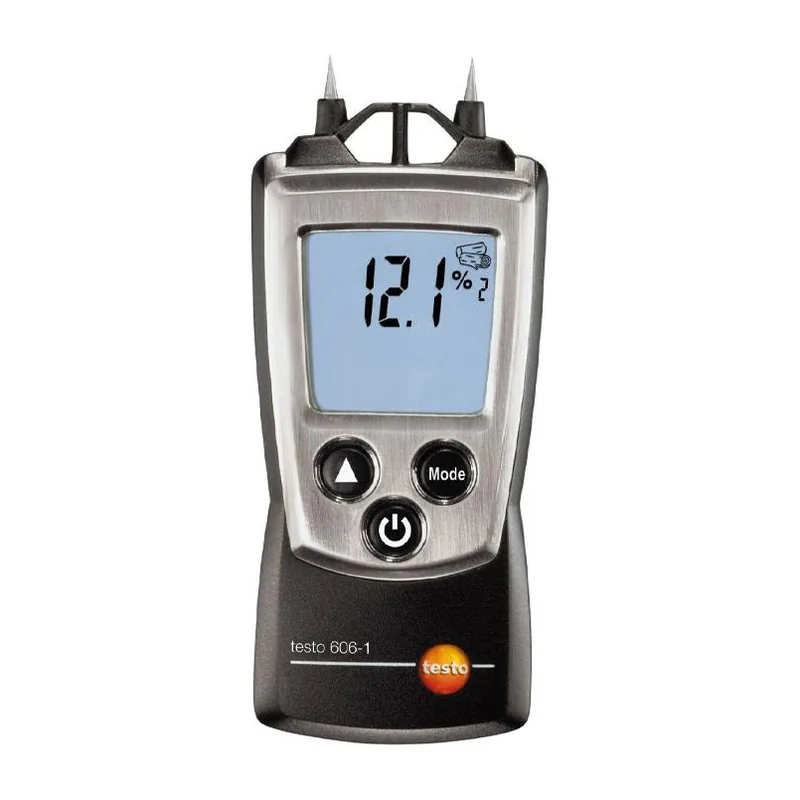
8.0/10
£106.80
Best pinless choice
Laserliner MoistureFinder CompactBest for: Finished surfaces that must not be punctured
6.9/10
£111.38
6.8/10
£23.98
The models side by side
The key differences between the models on our list. Click a model to read the full review.
Best overall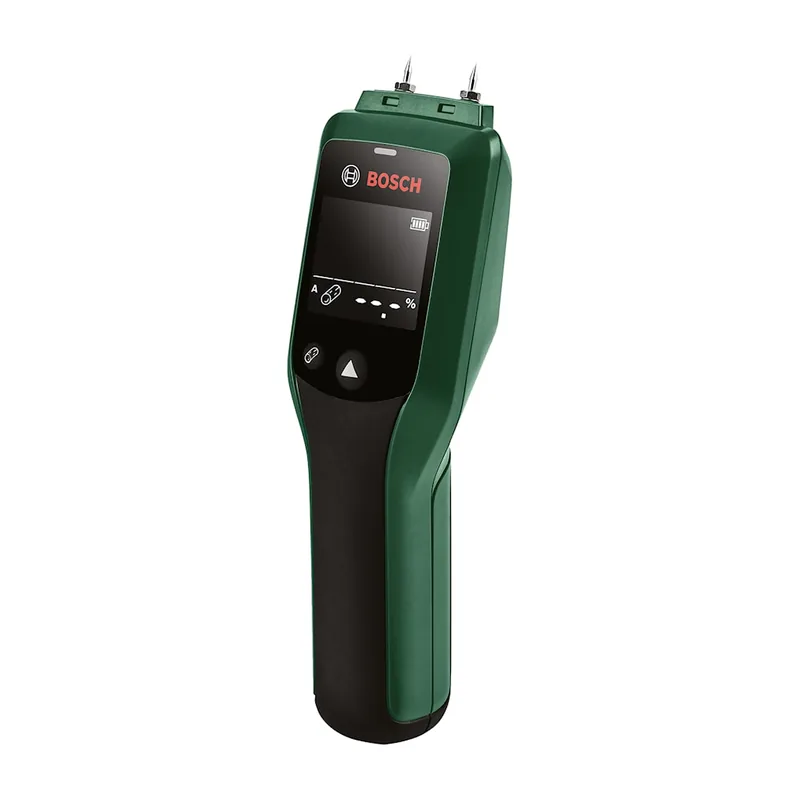 BoschUniversalHumid | #2Testo606-1Best for material-specific checks | #3LaserlinerMoistureFinder CompactBest pinless choice | #4BrennenstuhlMoisture Detector MDBest budget choice | #5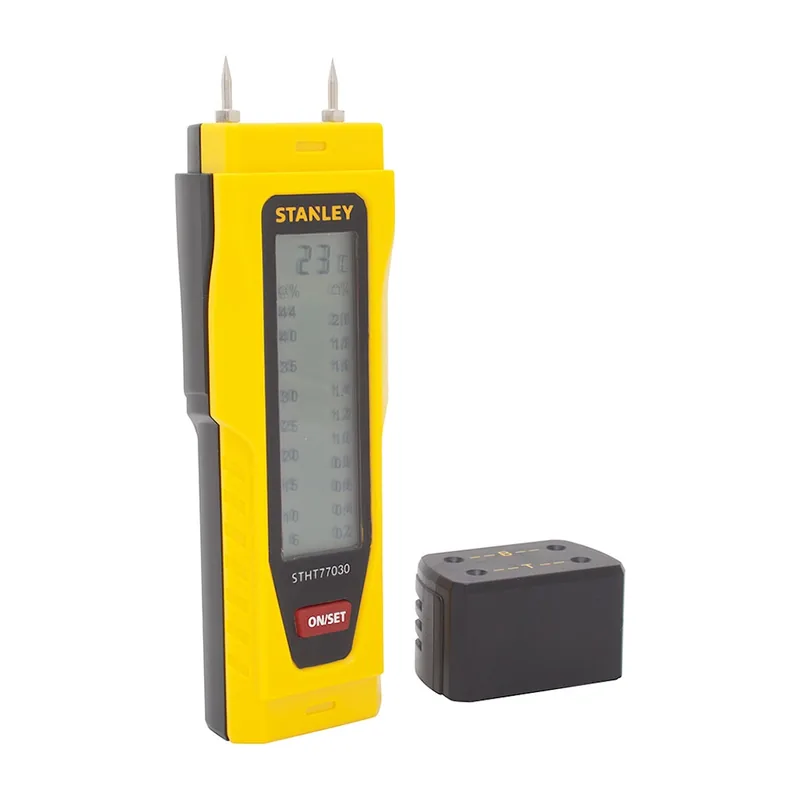 Stanley0-77-030Best for simple bar-graph checks | |
|---|---|---|---|---|---|
| Price | £43.12 | £106.80 | £111.38 | £23.98 | £24 |
| Method | Pins / conductivity | Pins | Pinless / capacitive | Pins | 8 mm pins |
| Building materials | No building-material scale | Five curves; concrete 0.9–22.1% | Plaster and cement screed modes | 1.5–33% | 0.2–2.0% |
| Stated accuracy | Typical ±1% | ±1% | Check model-specific manual | Not stated by manufacturer | ±2% |
| Best for | Firewood and timber checks | Renovation involving several known materials | Finished surfaces that must not be punctured | Occasional low-cost screening | Basic wood and masonry checks |
| Score | 8.1 | 8.0 | 6.9 | 6.8 | 6.1 |
Find the right moisture meter
Answer five questions about materials, surfaces and budget. This selector does not diagnose damp.
Best for: Firewood and timber checks

Bosch
1. Bosch UniversalHumid
Sub-scores and weighting by criterion
- Measurement range and stated accuracyweight 30%
- 8.5/10
8.5 out of 10 - Material support and measurement methodweight 25%
- 6.5/10
6.5 out of 10 - Ease of use and readabilityweight 20%
- 9.0/10
9.0 out of 10 - Priceweight 15%
- 9.0/10
9.0 out of 10 - Durability and maintenanceweight 10%
- 7.5/10
7.5 out of 10
In short
A wood-focused choice with selectable species groups and clear colour guidance. Its leading position does not make it suitable for measuring plaster or masonry.
Compiled by Marcello Rongione · Updated
Who is the Bosch UniversalHumid for?
Best for checking firewood and general timber, with selectable wood groups and clear colour feedback that make a quick stack check straightforward. It has no calibrated building-material mode, so choose something else if you also need to check plaster or masonry after a leak.
A first choice with a clear boundary
UniversalHumid makes most sense beside a log store or woodworking bench. It is designed around timber, with selectable wood groups rather than a general-purpose wall setting. That focus is why it leads this selection for wood, but it is also the main reason to choose something else for checking plaster after a leak.
The published ranges are 7.1–74.7% for group A and 6.4–61.9% for group B. Select the appropriate group before taking a reading. A broad range is useful, but it should not be mistaken for proof that the meter is equally accurate throughout every part of that range.
Pros
- Two selectable wood groups
- Traffic-light indication alongside readings
- Self-test and automatic switch-off
Cons
- No calibrated building-material mode
- Pins mark timber surfaces
Key specifications
Bosch- Brand
- Bosch
- Price
- £43.12
- Method
- Pins / conductivity
- Wood
- Group A: 7.1–74.7%; B: 6.4–61.9%
- Building materials
- No building-material scale
- Stated accuracy
- Typical ±1%
- Battery
- 3 × AAA, included
- Best for
- Firewood and timber checks
- Overall score
- 8.1 / 10
Best for: Renovation involving several known materials
Testo
2. Testo 606-1
Sub-scores and weighting by criterion
- Measurement range and stated accuracyweight 30%
- 9.0/10
9.0 out of 10 - Material support and measurement methodweight 25%
- 8.5/10
8.5 out of 10 - Ease of use and readabilityweight 20%
- 8.0/10
8.0 out of 10 - Priceweight 15%
- 5.0/10
5.0 out of 10 - Durability and maintenanceweight 10%
- 8.0/10
8.0 out of 10
In short
Selectable material curves and a backlit numerical display suit more demanding renovation checks. Its extra cost is harder to justify for firewood alone.
Compiled by Marcello Rongione · Updated
Who is the Testo 606-1 for?
Best for renovation work that moves between timber, plaster and masonry, thanks to its selectable material curves and backlit numerical display. It costs substantially more than the simpler pin meters, so if you only ever check firewood, that extra cost is harder to justify.
Paying for the right material curve
The case for Testo 606-1 begins with what you intend to measure. It combines wood settings with curves for building materials, rather than asking one generic scale to cover every renovation job. That makes it a more relevant option than the wood-only Bosch when the work moves between timber and known masonry or plaster materials.
Its electrodes are pressed into the material and readings are expressed as a percentage based on dry mass. Select the matching material curve first. A numerical result is only useful when its underlying scale suits the surface being checked; a percentage from one material cannot simply be compared with the same percentage from another.
Pros
- Material-specific wood and building curves
- Backlit display and hold function
- Approx. 200-hour battery life without backlight
Cons
- Costs substantially more than the basic pin meters
- Does not measure room relative humidity
Key specifications
Testo- Brand
- Testo
- Price
- £106.80
- Method
- Pins
- Wood
- 7.0–54.8%, across two wood curves
- Building materials
- Five curves; concrete 0.9–22.1%
- Stated accuracy
- ±1%
- Battery
- 2 × AAA; approx. 200 hours
- Best for
- Renovation involving several known materials
- Overall score
- 8.0 / 10
Best for: Finished surfaces that must not be punctured
Laserliner
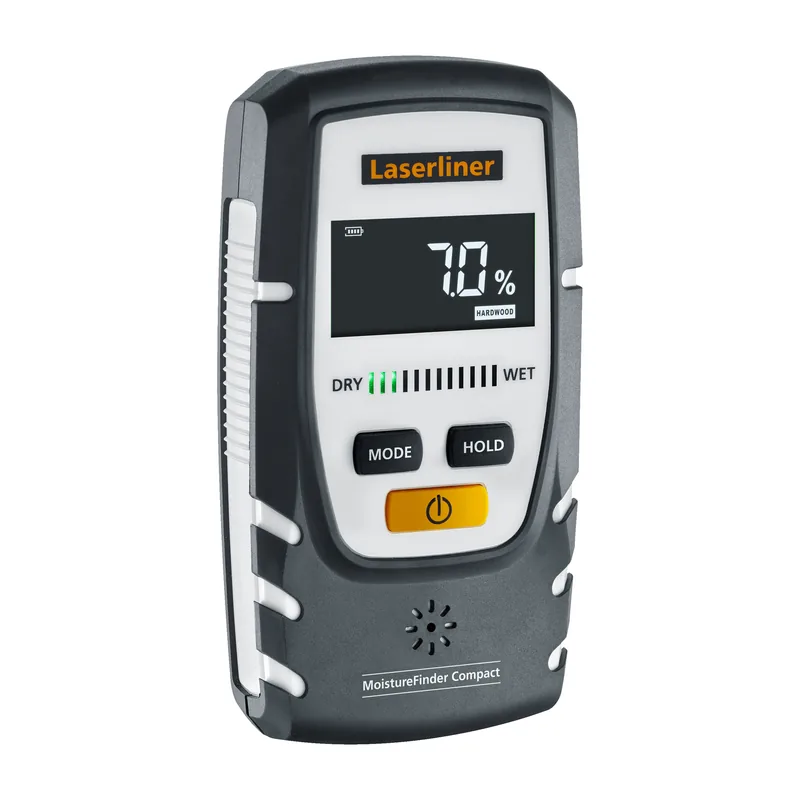
3. Laserliner MoistureFinder Compact
Sub-scores and weighting by criterion
- Measurement range and stated accuracyweight 30%
- 6.5/10
6.5 out of 10 - Material support and measurement methodweight 25%
- 7.5/10
7.5 out of 10 - Ease of use and readabilityweight 20%
- 8.0/10
8.0 out of 10 - Priceweight 15%
- 4.5/10
4.5 out of 10 - Durability and maintenanceweight 10%
- 7.5/10
7.5 out of 10
In short
Capacitive sensing avoids pinholes and offers modes for wood, plaster and screed. Choose it for non-destructive screening, not proof that a whole wall is dry.
Compiled by Marcello Rongione · Updated
Who is the Laserliner MoistureFinder Compact for?
Best for checking a finished wall, floor or piece of furniture without leaving pinholes, with dedicated modes for softwood, hardwood, plaster and cement screed. It is the most expensive model here and its readings can be affected by metal or concealed fixings, so choose a pin meter instead if you want a lower cost or know hidden metalwork is likely nearby.
Keep the finish intact
Avoiding pinholes is the central reason to consider MoistureFinder Compact. Its capacitive method takes a reading with the instrument against the surface, rather than driving electrodes into it. That changes the practical decision on decorative timber or a finished wall where even small punctures would be unwelcome.
The selectable material modes cover softwood, hardwood, plaster and cement screed. This is useful breadth, but not permission to treat every wall covering or composite board as an exact match. Establish what lies beneath the finish and use the relevant instructions before attaching significance to the displayed number.
Pros
- Checks surfaces without pinholes
- Four selectable material modes
- Coloured LED indication and audible warning
Cons
- Metal and concealed installations can affect readings
- Costs more than every other model here
Key specifications
Laserliner- Brand
- Laserliner
- Price
- £111.38
- Method
- Pinless / capacitive
- Wood
- Softwood and hardwood modes
- Building materials
- Plaster and cement screed modes
- Stated accuracy
- Check model-specific manual
- Battery
- 9 V
- Best for
- Finished surfaces that must not be punctured
- Overall score
- 6.9 / 10
Best for: Occasional low-cost screening
Brennenstuhl
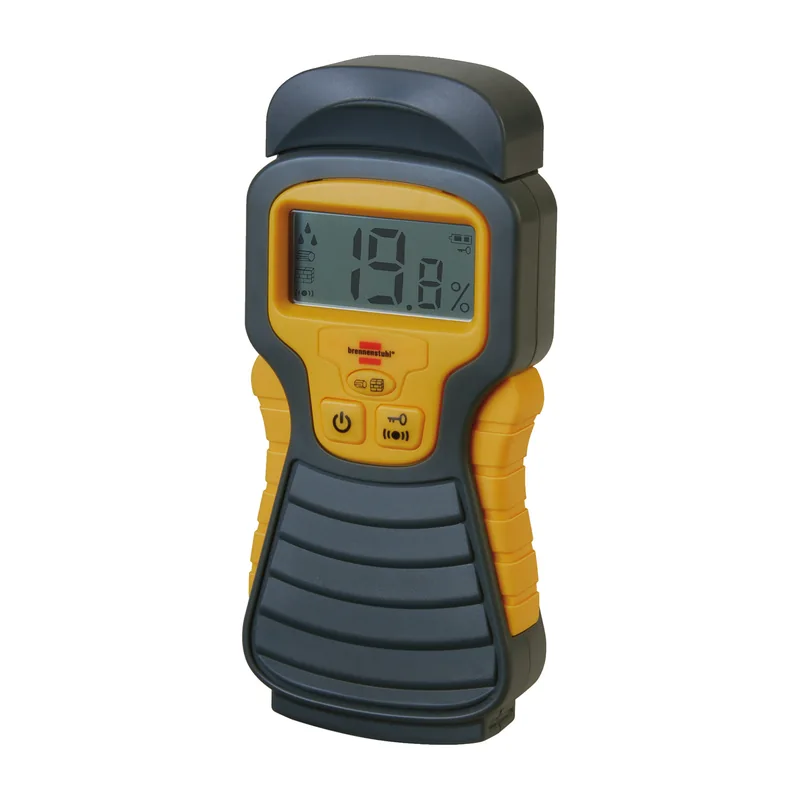
4. Brennenstuhl Moisture Detector MD
Sub-scores and weighting by criterion
- Measurement range and stated accuracyweight 30%
- 5.0/10
5.0 out of 10 - Material support and measurement methodweight 25%
- 7.0/10
7.0 out of 10 - Ease of use and readabilityweight 20%
- 7.5/10
7.5 out of 10 - Priceweight 15%
- 9.5/10
9.5 out of 10 - Durability and maintenanceweight 10%
- 6.5/10
6.5 out of 10
In short
A low-cost way to compare surface readings in wood and building materials. The absent accuracy specification limits how confidently small differences can be interpreted.
Compiled by Marcello Rongione · Updated
Who is the Brennenstuhl Moisture Detector MD for?
Best for occasional, low-cost comparisons around the house, with both wood and building-material modes at the lowest price in this selection. It has no published manufacturer accuracy figure, so choose Bosch or Testo instead if a decision depends on trusting a small difference between readings.
A low entry price, with a useful caveat
Brennenstuhl Moisture Detector MD is the least expensive model at the checked UK prices. Machine Mart lists it at £23.98 including VAT. That makes it a plausible tool for occasional comparisons around the home, particularly when you do not want to spend much before establishing whether you need more specialised equipment.
The important qualification is the missing manufacturer accuracy figure. A display with a percentage does not by itself establish how close that value is to the true moisture content. We would be cautious about using a small difference between readings to make a costly decision, particularly where the material or measurement conditions have changed.
Pros
- Lowest checked price in this selection
- Wood and building-material modes
- Hold function for awkward positions
Cons
- No published manufacturer accuracy figure
- Requires a separately purchased 9 V battery
Key specifications
Brennenstuhl- Brand
- Brennenstuhl
- Price
- £23.98
- Method
- Pins
- Wood
- 5–50%
- Building materials
- 1.5–33%
- Stated accuracy
- Not stated by manufacturer
- Battery
- 9 V, not included
- Best for
- Occasional low-cost screening
- Overall score
- 6.8 / 10
Best for: Basic wood and masonry checks
Stanley
5. Stanley 0-77-030
Sub-scores and weighting by criterion
- Measurement range and stated accuracyweight 30%
- 5.5/10
5.5 out of 10 - Material support and measurement methodweight 25%
- 6.5/10
6.5 out of 10 - Ease of use and readabilityweight 20%
- 6.0/10
6.0 out of 10 - Priceweight 15%
- 6.0/10
6.0 out of 10 - Durability and maintenanceweight 10%
- 7.0/10
7.0 out of 10
In short
Separate scales and a bar graph suit quick checks without complex menus. The display and short pins make it less suitable for detailed moisture records.
Compiled by Marcello Rongione · Updated
Who is the Stanley 0-77-030 for?
Best for quick checks using separate wood and masonry scales without needing to learn a material menu, helped by built-in test sockets for a self-check. Its bar-graph display is harder to read precisely and its 8 mm pins only sample the surface, so choose a numerical or pinless meter instead if you want detailed records or a deeper assessment.
Read the scale before choosing
Stanley 0-77-030 takes a deliberately simple approach: two detection pins and an LCD bar graph with separate scales for wood and building materials. That can suit someone who wants a quick visual indication rather than a menu-driven instrument. It is less appealing if you want to write down small numerical changes over successive visits.
The stated wood range is 6–44%, while the masonry scale runs from 0.2–2.0%. Those very different ranges are a reminder that material percentages are not universal. A value that seems low beside a timber reading can mean something different on a building-material scale, so read the correct side of the display.
Pros
- Separate wood and masonry scales
- Test sockets in the protective cap
- Wickes lists supplied batteries and pouch
Cons
- Bar-graph display is less precise to read than a numerical result
- 8 mm pins do not assess an entire wall or thick board
Key specifications
Stanley- Brand
- Stanley
- Price
- £24
- Method
- 8 mm pins
- Wood
- 6–44%
- Building materials
- 0.2–2.0%
- Stated accuracy
- ±2%
- Battery
- 4 × AAA, supplied by Wickes
- Best for
- Basic wood and masonry checks
- Overall score
- 6.1 / 10
The shortlist
Other models we considered – and why they did not make the list
5 reviewed · 5 selected · 0 ruled out – see why
See whyHide
The shortlist
Other models we considered – and why they did not make the list
5 reviewed · 5 selected · 0 ruled out – see why
We compared these models with the top list. Under each one we explain what set it apart from the five we picked – such as price, test results, features or availability in the UK.
Buying guide
Choosing a moisture meter for a UK home
- By Marcello Rongione · Updated 2026-11-19
- 6 sections
- About 2 min read
Decide whether you need to assess timber, compare building surfaces or avoid marking a finish. A material-moisture meter and a room hygrometer answer different questions.
How dry should firewood be before you burn it?
Back to topWoodsure advises using firewood at 20% moisture or less. Ready to Burn is a useful purchasing cue, but storage conditions can change moisture content. Check your appliance guidance too.
Measure a freshly split face with a pin meter, following the instrument’s wood selection and insertion instructions. Sample logs from different parts of the stack rather than relying on one exposed piece.
Which moisture meter suits your household?
Back to topThe right choice depends on what you are actually measuring, not just on which model has the longest spec sheet. Here are five common situations and which models in this test fit them, based on method, material support and stated accuracy.
For checking firewood before you burn it
Bosch UniversalHumid is built around timber, with two selectable wood groups and a traffic-light indication that makes a quick stack check easy to read. It leads this test for wood for that reason. It has no calibrated building-material mode, so it is the wrong tool the day you need to check a damp wall instead.
For renovation work across several materials
Testo 606-1 pairs wood and building-material curves with a backlit numerical display, which suits someone moving between timber, plaster and masonry on the same job. It costs substantially more than the basic pin meters here, so the extra outlay is easier to justify if you will genuinely use more than one material setting.
For a finish you don't want to puncture
Laserliner MoistureFinder Compact measures by holding the instrument against the surface, with modes for softwood, hardwood, plaster and cement screed. It is the most expensive model checked here, and metal or concealed installations can affect its readings, so treat a reading as a screening tool rather than final proof a wall is dry.
For occasional, low-cost checks around the house
Brennenstuhl Moisture Detector MD is the cheapest model in this selection and covers both wood and building-material modes, which suits someone who wants to compare a few spots without a big outlay. The manufacturer publishes no accuracy figure for it, so it is less suited to decisions that hinge on a small difference between readings.
For simple checks without a menu to learn
Stanley 0-77-030 uses separate wood and masonry scales on a straightforward bar graph, with test sockets built into the cap for a quick self-check. The 8 mm pins only sample the surface they touch, and the bar graph is harder to read precisely than a numerical display, so it suits a quick comparison rather than a detailed record over time.
Can a moisture meter tell you what's causing damp?
Back to topGOV.UK guidance for England distinguishes condensation, penetrating damp and rising damp. Condensation forms when moisture generated indoors meets colder building surfaces; leaks and building defects need different investigation.
A material reading cannot distinguish those causes. Report persistent damp or mould to your landlord or arrange a competent assessment; do not wait for a meter to validate visible symptoms. These five models do not measure room relative humidity.
Should you choose a pin or a pinless moisture meter?
Back to topPins make small holes and measure at the contact position. Ask permission before marking a surface, and keep sharp electrodes covered between uses. Bosch is wood-only; Testo adds material-specific curves.
Laserliner avoids punctures but requires appropriate material selection. Metal and concealed installations can influence readings. Neither approach proves that a whole construction is dry.
How do you get moisture readings you can actually compare?
Back to topUse the same instrument, material setting and measuring position when recording changes. Keep notes about surface condition and location. Do not compare a wood percentage directly with a masonry percentage.
Stated accuracy is not guaranteed performance in every real building. Brennenstuhl supplies no manufacturer accuracy figure; Stanley’s bar graph is less suitable for fine-grained records. Do not use a consumer reading alone to approve flooring or commission damp treatment.
How do you make sure you order the right model?
Back to topAll prices are dated UK snapshots including VAT and excluding delivery. Bosch includes AAA batteries; Brennenstuhl needs a separate 9 V battery. Wickes lists supplied batteries for Stanley.
Laserliner listings use different model suffixes and technical figures. Confirm the exact supplied manual, range and accuracy before ordering for a threshold-sensitive job. Dealer lead times and postcode stock checks are not guarantees of immediate availability.
Before you buy
Common pitfalls when buying moisture meters
A moisture meter is easy to misuse even when the display looks precise. These are the mistakes that cost you a useful reading, the costs that appear after the purchase, and the figures on the box that promise more than they deliver.
Common mistakes
- Comparing a wood percentage with a masonry percentage. Stanley's wood scale runs 6–44% and its masonry scale runs 0.2–2.0%. These are different scales for different materials, not two ends of the same number line.
- Measuring the outside of a log instead of a freshly split face. A dry-looking surface can hide higher moisture further in, so always check a freshly split face when assessing firewood.
- Treating a single reading as a diagnosis. A moisture meter cannot tell you whether damp is condensation, a leak or rising damp. Persistent damp or mould needs a proper assessment, not a percentage on a screen.
- Skipping the material or wood-group selection. Bosch UniversalHumid needs the correct wood group chosen before you read the result, and Testo 606-1 and Laserliner MoistureFinder Compact both rely on picking the right material curve or mode first.
- Marking a surface without checking first. Pin meters, including Bosch, Testo, Brennenstuhl and Stanley, leave small holes. Choose a discreet measuring point, and get permission before testing somebody else's timber or finish.
Hidden costs
- A battery that isn't in the box. Brennenstuhl Moisture Detector MD needs a 9 V battery that is not supplied, so factor that into the actual cost of getting it working.
- A separate hygrometer if you want room humidity. None of these five models measures room relative humidity, so a damp-condensation question indoors may still need a separate instrument.
- Buying the wrong listed variant. Laserliner's UK listings use different model suffixes with varying published figures. Confirm the exact supplied version and manual before you rely on its material modes for a specific job.
- Paying for material curves you won't use. Testo 606-1 costs substantially more than the basic pin meters here. That is easier to justify if you regularly check more than one material, and harder to justify for firewood alone.
Figures that look better on paper
- A wide measurement range. Bosch's wood groups span 7.1–74.7% and 6.4–61.9%, but a broad range does not mean the meter is equally accurate at every point within it.
- A stated accuracy percentage. Figures such as Testo's ±1% or Stanley's ±2% are published specifications, not something we have measured ourselves in every building.
- No accuracy figure at all. Brennenstuhl's absent manufacturer figure does not automatically mean worse performance, but it does mean you cannot confidently judge a small difference between two of its readings.
- Several material modes on one device. Laserliner's four modes sound comprehensive, but each still has to be matched correctly to the actual material beneath the surface, not just selected because it is available.
- A precise-sounding accuracy spec on an imprecise display. Stanley states ±2% accuracy, yet its bar-graph presentation still limits how finely you can read and record an actual value.
Frequently asked questions
Which moisture meter is best for firewood?
Bosch UniversalHumid is our wood-focused first choice. Use the correct wood group and measure a freshly split face rather than relying on the weathered outside of a log.
What moisture level should firewood have?
Woodsure advises 20% or less for firewood. Ready to Burn provides a useful purchasing cue; repeat checks after storage and follow your stove instructions.
Can these meters diagnose rising damp?
No. A reading does not identify the cause of damp or replace a competent building assessment. Condensation, leaks and other defects need different responses.
Do these meters measure humidity in the air?
No. These are material-moisture tools. Choose a separate hygrometer or environmental monitor if you want to track room relative humidity.
Is a pinless meter better?
It avoids pinholes, which matters on finished surfaces. Material selection, metal and the construction beneath the surface still affect interpretation.
Which moisture meter is cheapest?
Brennenstuhl Moisture Detector MD is the lowest-priced model in this selection and covers both wood and building-material modes. It has no published manufacturer accuracy figure, so treat it as a tool for comparison rather than precise record-keeping.
Which moisture meter is best for checking plaster or screed?
Testo 606-1 and Laserliner MoistureFinder Compact both offer material-specific settings that include plaster or screed, rather than a single general-purpose scale. Select the correct material setting before reading, since the same percentage means something different on different materials.
Do moisture meters come with batteries included?
It varies by model. Bosch UniversalHumid includes its AAA batteries, and Stanley 0-77-030 is supplied with AAA batteries by its retailer, while Brennenstuhl Moisture Detector MD requires a separately purchased 9 V battery. Check the listing for your chosen model before you buy.
How we compiled the evidence
How we choose the best moisture meters
Measurement range, materials covered and how clearly each meter reads for firewood, timber and damp walls. Measurement range and stated accuracy carries the most weight: 30 per cent. The scores are editorial assessments of the combined evidence, not results from our own hands-on tests.
Sources used in this guide
Step 1 · What we weigh
Scoring criteria and weighting
Measurement range and stated accuracy carries the most weight: 30 per cent. Click an area to see what it covers.
Measurement range and stated accuracy
30% of the scoreStated accuracy is the manufacturer's specification, not our own measurement.
Highest sub-score for measurement range and stated accuracy: Testo 606-1 with 9.0 out of 10.
Step 2 · The result
How we calculated the scores
All five models are assessed against the same five criteria. The criteria carry different weights: measurement range and stated accuracy 30 %, material support and measurement method 25 %, ease of use and readability 20 %, price 15 %, durability and maintenance 10 %. The overall score is the weighted sum of the sub-scores, rounded to one decimal place.
Overall scoremeasurement range and stated accuracy × 30%material support and measurement method × 25%ease of use and readability × 20%price × 15%durability and maintenance × 10%
| Model and sub-scores (Measurement range and stated accuracy, Material support and measurement method, Ease of use and readability, Price, Durability and maintenance) | Overall score |
|---|---|
| Bosch UniversalHumid8.5 · 6.5 · 9 · 9 · 7.5 (sub-scores) | 8,1/10 |
| Testo 606-19 · 8.5 · 8 · 5 · 8 (sub-scores) | 8,0/10 |
| Laserliner MoistureFinder Compact6.5 · 7.5 · 8 · 4.5 · 7.5 (sub-scores) | 6,9/10 |
| Brennenstuhl Moisture Detector MD5 · 7 · 7.5 · 9.5 · 6.5 (sub-scores) | 6,8/10 |
| Stanley 0-77-0305.5 · 6.5 · 6 · 6 · 7 (sub-scores) | 6,1/10 |
The method in detail
How we compiled this moisture-meter comparison
This is a desk-based editorial comparison, not our own hands-on or laboratory test. We weigh published specifications, independent editorial material where suitable, customer information where verifiable and UK purchase evidence. No customer rating is asserted here.
Scoring framework
The retained criteria are measurement range and stated accuracy (30%), material support and method (25%), ease of use and readability (20%), price (15%), and durability and maintenance (10%). Scores and sub-scores are retained editorial assessments, not newly measured accuracy results. Temporary UK offers do not automatically change them.
Evidence and limitations
Manufacturer and dealer specifications supply the product facts. No recent, sufficiently detailed model-specific independent review was verified for an expert card, so none is presented. A buying-guide inclusion is not a controlled comparison of accuracy.
Retail listings were checked for exact model names and GBP prices. Where suffix-specific Laserliner figures conflict, we omit a single numerical accuracy claim rather than combine incompatible specifications. Consumer readings cannot replace a building survey or fuel certification.
Sources reviewed
- Manufacturer specifications
- UK retailer product pages
- GOV.UK housing guidance
- Woodsure firewood guidance
Reviewed by
Marcello Rongione
Editor, Electronics, Health & Fitness and Garden & DIY
Last reviewed 19 November 2026
Sources and references
References for the details on method, wood, building materials, stated accuracy, battery and guidance for choosing moisture meters. Each link is described below.
- 1Bosch UniversalHumid — Bosch DIY UKProduct page with price, stock and specifications.
- 2Testo 606-1 — Tester.co.ukProduct page with price, stock and specifications.
- 3Laserliner MoistureFinder Compact — Fixings and Powertool CenterProduct page with price, stock and specifications.
- 4Brennenstuhl Moisture Detector MD — Machine MartProduct page with price, stock and specifications.
- 5Stanley 0-77-030 — WickesProduct page with price, stock and specifications.
- 6Damp and mould guidance (England)Guidance used for UK context in this guide.
- 7Woodsure: using a moisture meterGuidance used for UK context in this guide.
The highest overall score is our weighted verdict for moisture meters. If durability and maintenance matters more to you than measurement range and stated accuracy, another of our picks may suit you better.